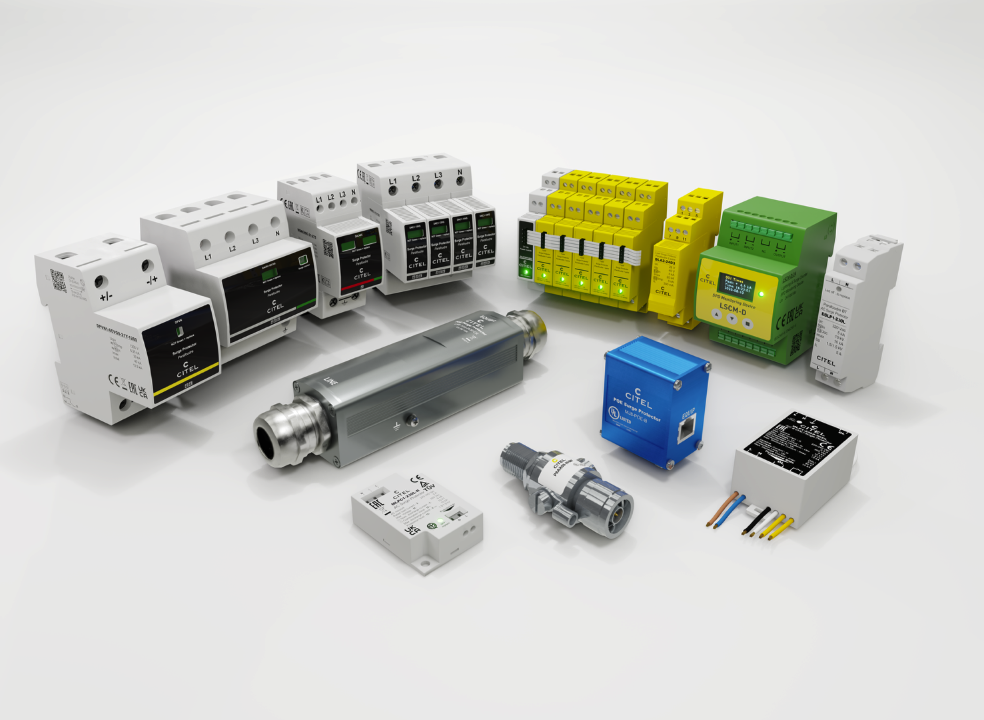
Surge Protection for Wind Turbine
Necessity of Surge Protection
Wind turbines are at high risk of lightning strikes
Wind turbines are usually located in open areas with excellent wind resources. For example, onshore wind power generation is located in protruding terrain such as ridges, while offshore wind power generation isusually located in areas with high ground flash density near coastlines. At the same time, blades of the wind turbines can induce and trigger upward leaders and actively connect with downward leaders in electrostatic fields of thunderstorms, which greatly increases the probability of lightning striking the blades. For this reason, the estimated annual average number of lightning strikes on wind turbines is much higher here than in other areas.
High maintenance costs
Lightning strikes on a wind turbine may cause blade ablation, a failure of an electrical and control system, and other phenomena. There are many such cases. The yield loss caused by wind turbine maintenance and downtime is very large. For an offshore wind turbine, the maintenance costs are particularly high, and the maintenance period is long. As a result, a big indirect loss is brought by the halt.
The threat caused by a lightning electromagnetic pulse is huge
Compared with direct lightning strikes, the indirect effect of lightning strikes, namely a lightning electromagnetic pulse (LEMP), is more risky to the electrical and control system of the wind turbine. The main reasons are as follows:
• the probability of lightning strikes on wind turbine blades is high, and the radiated electromagnetic field can cover the entire wind power plant; • the operating systems of sensitive equipment, such as a main control and a pitch control system, have low immunity; • the components and parts of the equipment have low capacity to endure LEMP and are prone to breakdown or insulation damage; • the cable length of the interconnection betwenn the wind turbines and the distance to the grid connection point is long in open areas. The inducted overvoltage can by very significant.
Reasonable installation of SPD is the most effective method
LEMP is currently the main threat for breakdowns and failures of the electrical and electronic system. At present, the most cost-effective and reasonable main measures are taken: installing a surge protective device (SPD), which discharges the energy matches with the endurance capability of the protected equipment and the immunity of the system, at the boundaries of the lightning protection zones or at the front end of the protected equipment.
SPD 安装
位置 | 位置 | 型号 | |
|---|---|---|---|
1 | Protection of the low voltage side of the substation |
| |
2 | Protection of the low voltage side of the substation |
| |
3 | Converter grid side protection |
| |
4 | Converter machine side protection |
| |
5 | Converter machine side protection |
| |
6 | Single-phase AC power 230 Vac |
| |
7 | 3-phase power supply 230/400 Vac |
| |
8 | Single-phase AC power 230 Vac |
| |
9 | DC power supply 24 Vdc |
| |
10 | Telecommunication signal lines |
| |
11 | Data communication network |
| |
12 | Lightning strike monitoring system |
|
PDF-SPDs for Wind Turbine | Video-SPDs for Wind Turbine installation |
|---|---|
|
|